Thursday, Delaware Medicaid Narrows Who Counts. Refugees, Asylees, and Even Some Veterans Are on the Cut List.
Wednesday, September 30, 2026 · 34 days to November 3
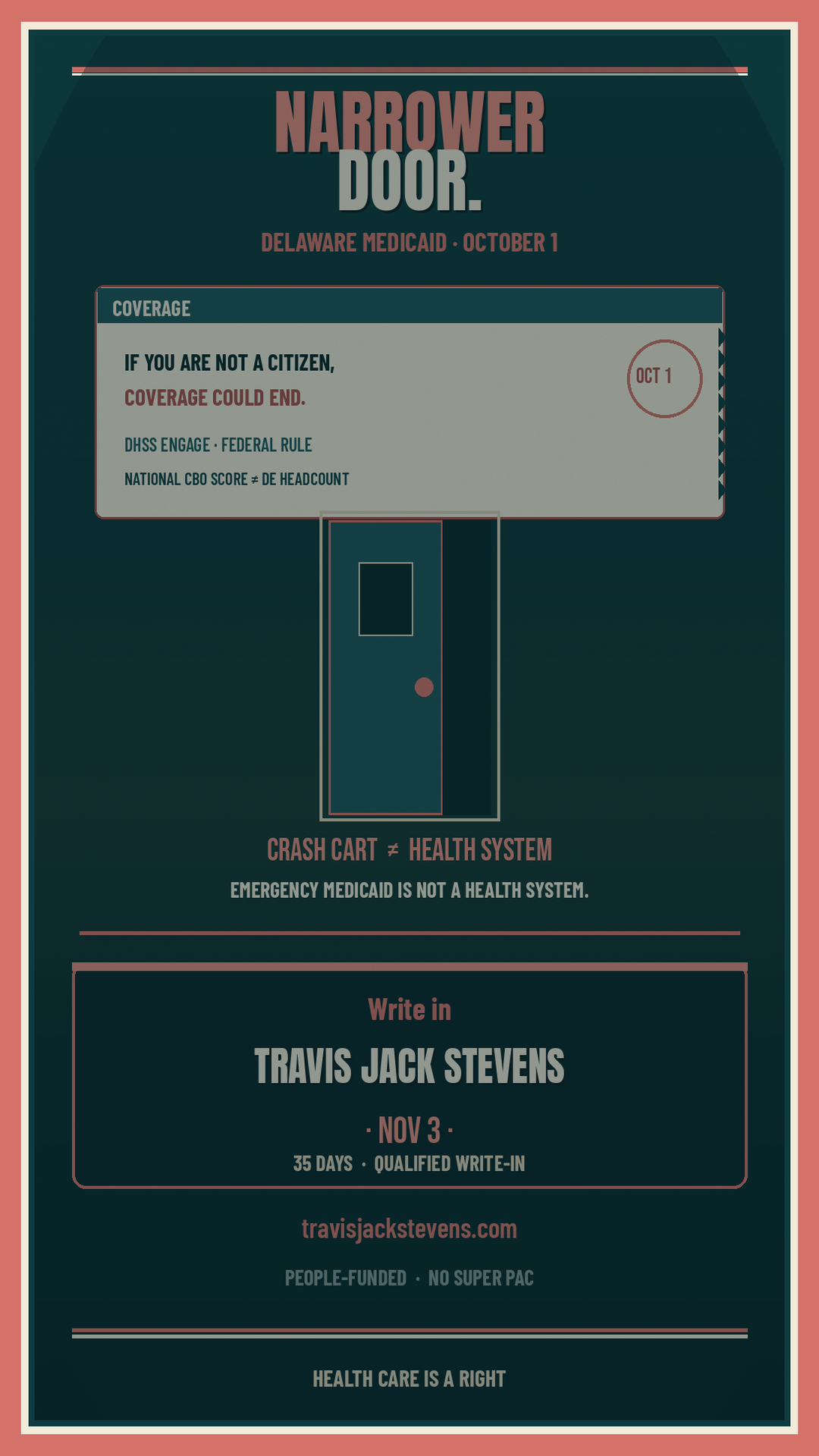
On Thursday, October 1, federal Medicaid rules change in Delaware. The Delaware Department of Health and Social Services is not whispering about it. Its Medicaid ENGAGE page says it plainly: if you are not a U.S. citizen, your coverage could end because of a new federal law (DHSS Medicaid ENGAGE).
I spent years as a travel ICU nurse. Coverage is not paperwork. Coverage is whether someone can fill a prescription, get a follow-up, or walk into a clinic before the emergency room is the only door left.
So read the state’s own list.
Starting October 1, noncitizens generally need one of a short set of statuses for full Medicaid benefits: a lawful permanent resident (green card) who has cleared the five-year wait or is exempt from it; a Cuban or Haitian entrant; or a COFA migrant from the Marshall Islands, Micronesia, or Palau. Pregnant women and children can still qualify under Delaware’s CHIPRA 214 option even when their status is not on that list. Refugees may get full coverage for only the first four months of refugee status — then they drop to emergency and labor-and-delivery services unless they hold a qualifying status (DHSS Medicaid ENGAGE).
And here is the part Washington hopes you skim past. Delaware’s own guidance says you will no longer qualify for full Medicaid after October 1 if you are, among others: an asylee; a refugee past that four-month window without a qualifying status; a parolee — including certain Afghan and Ukrainian parolees named in federal appropriations; a person whose deportation is being withheld; a VAWA petitioner who has been battered or subjected to extreme cruelty; a trafficking victim and certain family members; an Amerasian immigrant; or a noncitizen honorably discharged veteran, an active-duty service member, and their spouse or unmarried dependent children (DHSS Medicaid ENGAGE).
Sit with that. A federal law that strips full Medicaid from people who fled violence, from people Congress brought here under parole, and from noncitizen veterans who wore the uniform. That is not a paperwork glitch. That is a choice about whose body gets care.
What remains, and what does not
People who lose full coverage may still get Emergency Medicaid — but only for labor and delivery, or a sudden life-threatening situation or severe acute illness or injury that demands immediate attention, and only in a hospital emergency room, acute inpatient hospital, or birthing center (DHSS Medicaid ENGAGE). That is a crash cart, not a health system.
KFF’s September analysis of the 2025 reconciliation law’s immigrant eligibility restrictions says Medicaid and CHIP cuts take effect October 1, eliminate eligibility for many lawfully present immigrants including refugees and asylees without a green card, and — citing the Congressional Budget Office — will reduce federal spending by $6.2 billion and leave an additional 100,000 people uninsured by 2034 (KFF). That is a national CBO score, not a Delaware enrollment dump. Do not invent a local headcount. The state’s warning is enough: coverage can end Thursday, and someone else in your household can lose coverage even if yours holds (DHSS Medicaid ENGAGE).
This is the same ledger Delaware already saw last week when the state announced nearly $23 million for federally qualified health centers — Westside, La Red, Henrietta Johnson — while bracing for Medicaid reductions that stretch those clinics financially (Spotlight Delaware; campaign short: delaware-fqhc-awards-medicaid-cuts). Clinics get a modernization check. Patients get a narrower door. Ribbon-cuttings do not replace insurance cards.
January is next
October 1 is not the whole bill. Starting January 1, 2027, adults in Delaware’s Medicaid Expansion group (low-income adults ages 19–64) face federal work and community-engagement rules: earn at least $580 a month or complete at least 80 hours a month of work, volunteering, a work program, or school/job training — with renewals every six months instead of yearly (DHSS Medicaid ENGAGE). Exemptions exist on paper. Red tape is where people fall through.
If your immigration status changed, DHSS says update it now through the Change Report Center (302-571-4900, Option 2), ASSIST online, or a local office. Create a My ASSIST account. Keep your address and phone current. Read the mail. Call Medicaid Customer Relations at 1-866-843-7212 if you need help. For low- or no-cost care if coverage drops: 2-1-1, Delaware Public Health clinics, and HRSA health centers (DHSS Medicaid ENGAGE).
Where I stand
Universal health care means everyone — not everyone except the refugee past month four, the asylee, the parolee, the trafficking survivor, or the veteran who is not a citizen. A nation that asks people to follow the rules and then cancels their coverage on a Thursday is not serious about equal opportunity. I support universal health care because sick people cannot wait for Washington’s photo ops. Congress should reverse these eligibility cuts, protect Medicaid, and stop trading rural clinic grants against coverage itself.
I’m running as a write-in candidate for the U.S. Senate (Delaware Department of Elections). This campaign is funded by people. No Super PAC money. Ever.
Register by October 10 (iVote Delaware). On November 3, write in TRAVIS JACK STEVENS · travisjackstevens.com
Explore Topics
Written by
Travis Jack Stevens
Travis Jack Stevens spent years as a travel ICU nurse and is a write-in candidate for U.S. Senate · Delaware.