They're Watching Every Car You Drive. And Now Bipartisan Backlash Is Finally Pushing Back.

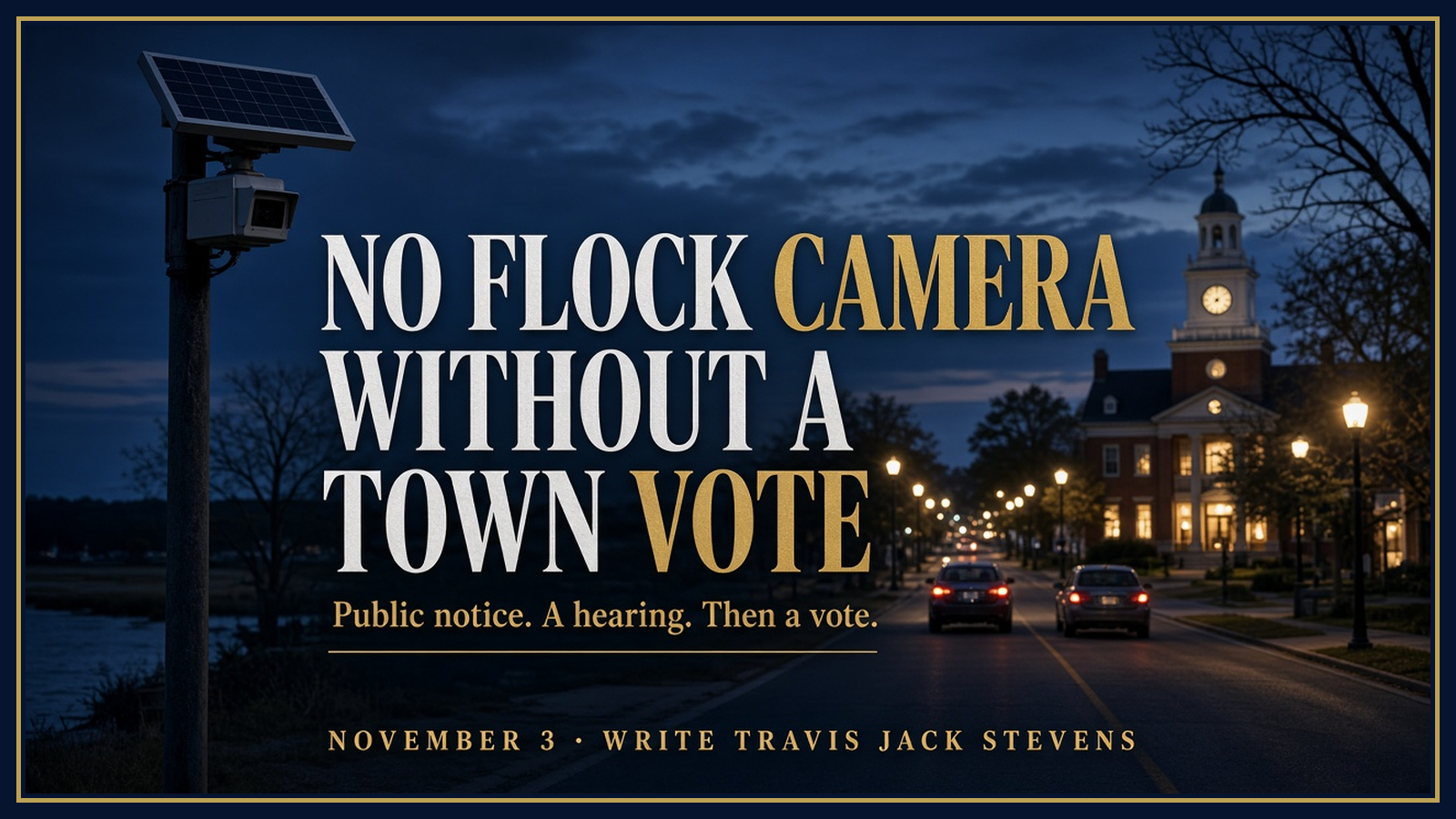
There are more than 5 million Flock Safety cameras deployed across the United States. They read your license plate every time you pass. They log where you were, when you were there, and how fast you were going.
Now Flock wants to track your driving patterns — without your plate, without your name, without any crime attached to your record.
This is not a future threat. It is happening right now. And for the first time, both parties are starting to say so.
Update: The Backlash Is Real — and Bipartisan
September 1, 2026
When I wrote about Flock Safety's surveillance network ten days ago, the story was being covered almost exclusively by left-leaning outlets. I noted that asymmetry directly — because the threat to privacy does not belong to one political party.
That has changed.
On Saturday, Texas Governor Greg Abbott — a Republican — ordered state agencies to halt all funding for Flock Safety cameras. The directive came just before a Texas Tribune investigation revealed that at least $30 million in state grants had been used to expand the Flock network across Texas. Abbott's freeze is not a ban — local and federal funding can still flow to existing cameras — but it is the most significant government action against Flock to date.
The trigger was not abstract privacy concerns. It was documented abuse. Investigations revealed that officers used the Flock system to stalk women and conduct unauthorized personal searches. The cameras built to catch criminals were being used by officers to surveil private citizens for personal reasons. There was no warrant. No investigation. No oversight that caught it.
U.S. Senator Josh Hawley — also a Republican — launched a formal inquiry into Flock's data practices, demanding CEO Garrett Langley explain how the company handles 20 billion monthly vehicle scans. That is not a typo. Twenty billion. Every month.
Cities and counties across the country are now terminating contracts with Flock. The ACLU broke the original story two months ago. It took a Texas Tribune investigation, a governor's order, and a Senate inquiry to make it national news.
That is how pressure works. That is why getting the information out matters.
"Public unease intensified over the vast network capturing billions of vehicle movements monthly across 49 states." — Ground News aggregation, September 1, 2026
What the Numbers Actually Show
The bipartisan backlash has surfaced data that Flock's marketing never highlighted:
- 71 percent failure rate for vehicle matches in independent analyses
- Less than 1 percent of all scans connect to any criminal investigation
- 20 billion vehicle movements captured every month across 49 states
- $30 million in Texas state grants alone — before Abbott's freeze
- Officers in multiple jurisdictions used the system for personal surveillance with no criminal nexus
Flock's response has been to reduce default data retention from 30 days to seven and add mandatory audit tools. Civil liberties lawyers note that seven days of data on 20 billion monthly scans is still an enormous surveillance database — and that "mandatory audit tools" mean nothing without mandatory audits.
What Flock Cameras Actually Do
Flock Safety markets its cameras as a tool to fight crime. The pitch is simple: mount a camera on a pole, read every plate that passes, and alert police when a wanted vehicle drives by.
More than 5,000 law enforcement agencies now use Flock. Thousands of private homeowners associations and businesses have installed them too — creating a private surveillance network that feeds data to police on request.
The New York Times Magazine reported in August that Flock's network has become one of the most comprehensive vehicle tracking systems ever built in a democracy. A single camera captures not just the plate — it captures the make, model, color, and any distinguishing features of the vehicle.
That data is stored. It is searchable. And it is shared.
"The Flock network is, in effect, a nationwide license plate reader that operates with almost no federal oversight." — New York Times Magazine, August 2026
Flock cameras have been used to track protesters, journalists, and domestic abuse survivors — not just criminals. The data retention window varies by contract. Many agencies held records for 30 days or longer. There is no federal law requiring them to delete it sooner. Flock recently reduced its default retention to seven days — but only after the Texas scandal broke.
The New Frontier: Tracking Without a Plate
NPR reported in August that Flock is now testing a new capability: cameras that track driving patterns without capturing a license plate, a name, or any connection to a crime.
The company calls it "anonymized" data collection. Civil liberties lawyers call it a legal fiction.
Here is why: if you track the same vehicle — same make, model, color, route, and time of day — you do not need a plate to identify the driver. You just need enough data points. Pattern recognition does the rest.
Flock says this new system will help cities study traffic flow. But the same infrastructure that studies traffic flow can study protest attendance, church attendance, and union meetings.
There is no law that stops it.
"They don't need your name. They don't need your plate. They just need to watch you long enough." — ACLU Technology and Liberty Project, 2026
The bipartisan backlash now unfolding — Abbott's freeze, Hawley's inquiry, cities terminating contracts — proves that when the public gets the information, pressure builds across party lines. Privacy is not a left issue or a right issue. It is an American issue. The question is whether it will produce federal legislation before the next abuse is documented.
The Vandals They Created — and What Actually Works
NBC News reported in August that people across the country have begun destroying Flock cameras. Spray paint. Hammers. Bags over the lens.
Flock calls them vandals. Some of them call themselves privacy advocates.
The company's response has been to announce modest privacy "improvements" — shorter data retention windows, clearer opt-out processes for homeowners associations.
The people destroying the cameras say it is not enough. They are right that the changes are inadequate. They are wrong that destruction is the answer.
The answer is legislation. The answer is public pressure that crosses party lines — which is exactly what we are now seeing. Abbott is not a civil libertarian. Hawley is not a privacy activist. They responded because constituents demanded it and journalists documented the abuse.
That is the model. That is what works.
Where Delaware Stands — And Where Coons Has Been Silent
Delaware has no comprehensive law governing automated license plate readers. No retention limits. No audit requirements. No prohibition on sharing data with out-of-state agencies.
Senator Chris Coons has served on the Senate Judiciary Committee for years. He has not introduced legislation to regulate ALPR technology. He has not held a hearing on Flock's expansion. He has not asked the company a single public question — not before the Texas scandal, and not after it.
Senator Hawley, a Republican, launched a federal inquiry. Governor Abbott, a Republican, froze state contracts. Delaware's Democratic senator has produced silence.
His campaign has accepted donations from technology industry PACs that have a direct financial interest in keeping this surveillance infrastructure unregulated.
That is not a coincidence. That is a choice.
My Five-Point Platform on Surveillance Technology
I am running as a write-in candidate for U.S. Senate in Delaware because the people of this state deserve a senator who will actually fight for their privacy.
1. Mandatory Data Retention Limits No ALPR data retained beyond 72 hours without a warrant tied to a specific, documented criminal investigation.
2. Prohibition on Pattern Tracking Ban the use of ALPR or behavioral tracking data to build movement profiles on individuals not under active investigation.
3. Audit Requirements All law enforcement agencies using ALPR technology must publish annual reports: how many plates captured, how many searches conducted, how many resulted in arrests.
4. Private Network Regulation HOA and private business cameras that share data with law enforcement must be subject to the same rules as police cameras.
5. The American Privacy in Public Spaces Act A federal floor that states can exceed but not fall below — establishing baseline rights for every American regardless of where they live.
The Fourth Amendment Was Written for This Moment
The Founders did not know about license plate readers. They did not know about pattern-recognition algorithms or behavioral tracking databases. But they understood something fundamental: a government that can watch everything you do in public — without suspicion, without a warrant, without any limit — is not a free government.
The Fourth Amendment protects against unreasonable searches. Tracking every vehicle in America, building movement profiles on ordinary citizens, and sharing that data across thousands of agencies without oversight is unreasonable by any honest reading of that word.
The question is whether we will have a senator who says so.
Sources: NPR (Aug. 21, 2026), New York Times Magazine (Aug. 21, 2026), NBC News (Aug. 21, 2026), Texas Tribune (Aug. 31, 2026), Ground News (Sep. 1, 2026), ACLU (Jun. 25, 2026)
Travis Jack Stevens is a declared write-in candidate for U.S. Senate in Delaware. Learn more at travisjackstevens.com.
Explore Topics
Written by
Travis Jack Stevens
Travis Jack Stevens spent years as a travel ICU nurse and is a write-in candidate for U.S. Senate · Delaware.