Two Americas: Lobster at the Pentagon, Broken Bunks on the Lincoln
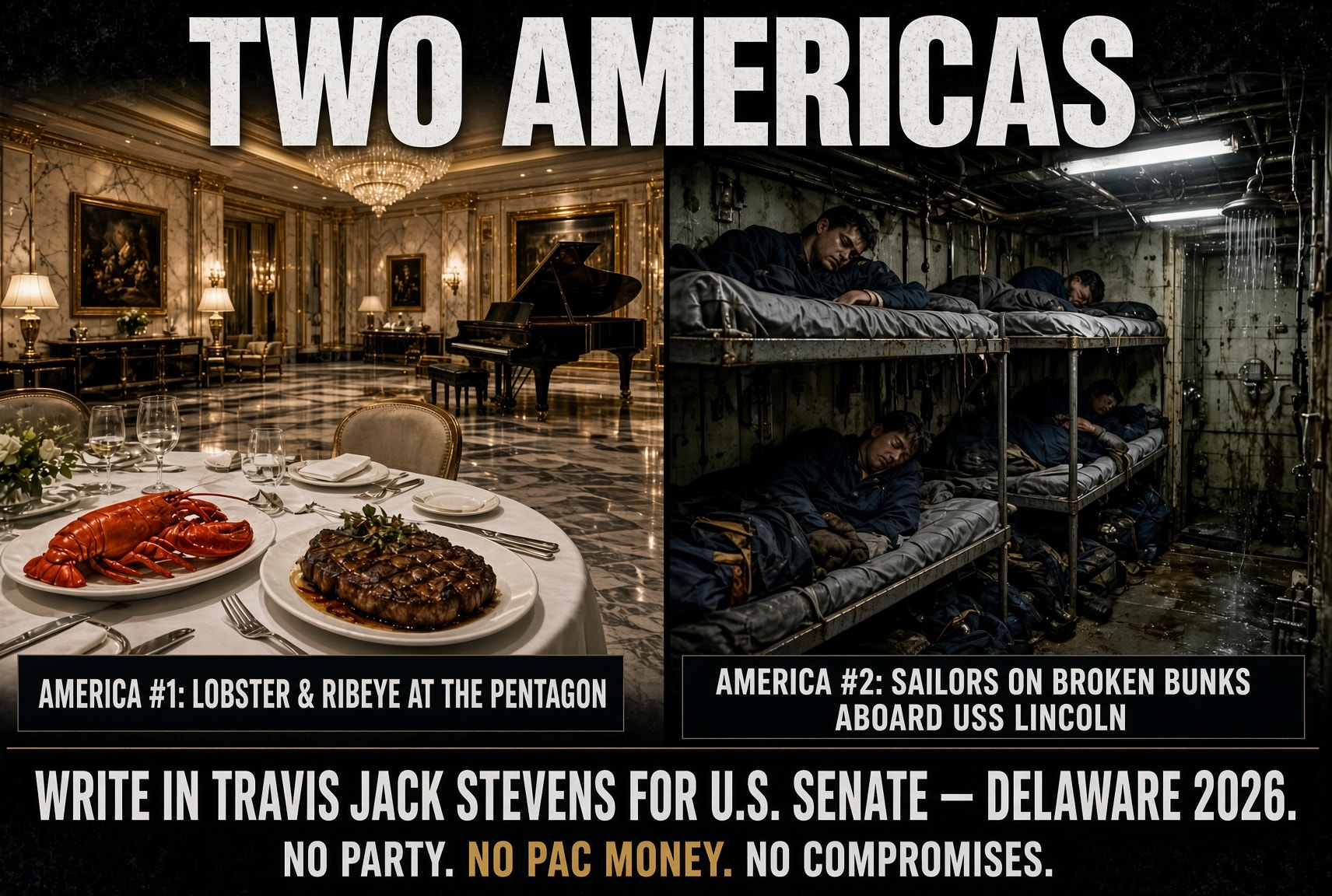
One America is eating lobster and ribeye at the Pentagon while a grand piano echoes down marble hallways.
The other America is sleeping in a broken bunk on a carrier that can't keep its showers running.
Both are real. Both are happening right now. And the people in charge of the first America are the ones deciding the fate of the second.
I want to walk you through what I've been watching — because I think you deserve to see it laid out plainly, without spin from either party.
America #1: The Pentagon's New Dining Room
Secretary Pete Hegseth has redecorated the Secretary of Defense's suite. Reports from inside the building describe a grand piano installed in the executive dining area, lobster and ribeye on the regular menu, and a renovation budget that Pentagon staff describe as "jaw-dropping."
This is happening inside a building that just received a $93 billion supplemental budget injection in a single month — money that moved through Congress faster than most Americans can pay a medical bill.
The total FY2026 defense budget now sits at $1.5 trillion. That is not a typo. One and a half trillion dollars. In a single year. For a country that can't fund school lunches without a fight.
To put that number in context: Delaware's entire annual state budget is roughly $5.5 billion. The Pentagon's monthly supplemental alone — $93 billion — is nearly 17 times what Delaware spends in a year on everything: schools, roads, healthcare, public safety, all of it.
By the numbers:
- $1,500,000,000,000 — FY2026 Pentagon budget
- $93B — supplemental added in a single month
- $0 — amount Hegseth has been confirmed to have cut from executive dining
Sources: FY2026 National Defense Authorization Act and supplemental appropriations; Pentagon renovation reporting, 2026; Delaware Office of Management and Budget, FY2026 Enacted Budget.
America #2: Life Aboard the USS Lincoln
While Hegseth's piano was being tuned, sailors aboard the USS Abraham Lincoln were dealing with broken bunks, unreliable showers, and a ship that has been deployed so long that crew morale has become a documented readiness concern.
The Lincoln has been in the Red Sea theater longer than any carrier in recent memory — extended repeatedly as the Gaza conflict drags on with no exit strategy and no end in sight. The sailors didn't choose this war. They didn't vote on it. They were sent.
Meanwhile, the DoD Inspector General released findings showing a 25% loss rate on MQ-9 Reaper drones in active theater operations — a figure that reflects not just hardware cost but the chaotic, under-resourced nature of how this administration is conducting its military operations.
Each Reaper costs roughly $30 million. A 25% loss rate in a single theater means one in four aircraft sent into combat doesn't come back. That's not a rounding error — that's a procurement scandal waiting for a hearing that will never happen.
I want to be precise about what this means for the people doing the actual work: the sailors on the Lincoln are being asked to sustain an indefinite deployment in degraded conditions, in support of a war with no defined objective, while the people managing that war from Washington are eating lobster and debating piano placement.
Sources: DoD Inspector General, MQ-9 Reaper operational loss report, 2026; USS Lincoln deployment reporting; Navy readiness assessments, 2025–2026.
The Air Force One Story Nobody Is Talking About Enough
When Trump abruptly changed his Air Force One flight path earlier this year, the official explanation was vague. What reporting has since revealed: the decision was based on CIA intelligence assessed at low confidence — a threat warning from Israeli sources that the CIA itself flagged as unreliable.
Think about what that means.
The President of the United States rerouted the most secure aircraft in the world based on intel that his own intelligence community rated as low-confidence — and that intel came from a foreign government currently under ICJ scrutiny for war crimes.
This is not a partisan point. This is a question about who is actually driving American foreign policy — and whether the American people have any say in it at all.
I wrote about the Air Force One episode in detail when it first broke. The pattern it reveals is consistent: a foreign government with enormous influence over American decision-making, operating through intelligence channels that our own analysts don't fully trust, shaping the movements and decisions of the American president.
That is not a healthy relationship. That is not what an alliance is supposed to look like.
Sources: CIA intelligence assessment reporting, 2026; ICJ Order, South Africa v. Israel, January 26, 2024; Air Force One flight path reporting, 2026.
The Wealth Gap Is Not an Accident
Since 2020, American billionaires have added more than $2 trillion in net worth. In that same period, the median American worker's real purchasing power has declined. Housing costs have risen faster than wages in every major Delaware market. Medical debt remains the leading cause of personal bankruptcy.
This is not a market failure. It is a policy choice.
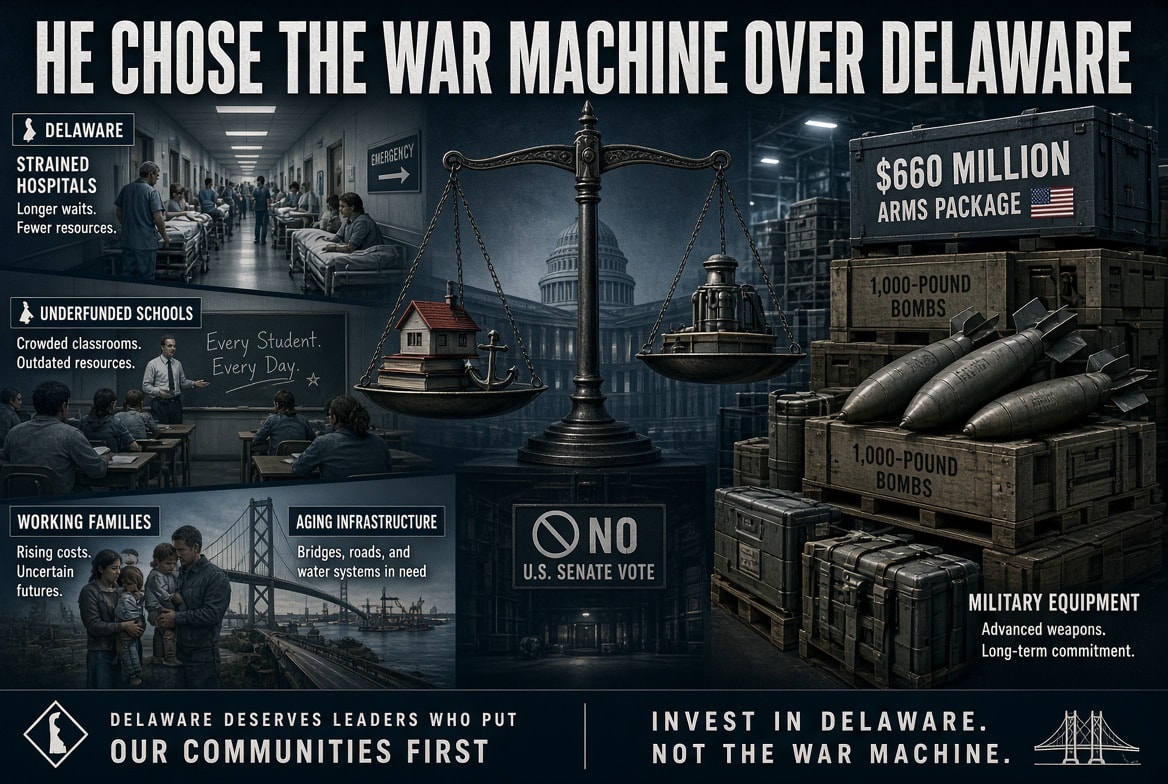
The same Congress that can pass a $93 billion Pentagon supplement in a month has not passed meaningful housing relief, drug pricing reform, or a living wage increase in years. The same Senate that approved $660 million in arms to Israel — a vote Senator Coons supported — cannot find the votes to cap insulin prices.
These are not unrelated facts. They are the same fact, expressed in different line items.
The wealth gap is the result of a political system that has decided, through hundreds of individual votes over decades, that the financial interests of the people at the top of the economy are more important than the material conditions of the people at the bottom. The defense budget is one of the primary mechanisms through which that decision gets made — because defense spending flows upward, to contractors and shareholders, while the costs of that spending flow downward, to taxpayers and the communities that don't get the domestic investment that money could have funded.
Sources: Federal Reserve, Distributional Financial Accounts, 2020–2026; Economic Policy Institute, real wage data; Kaiser Family Foundation, medical debt survey, 2025; Congressional Budget Office, FY2026 budget analysis.
What I Would Do Differently
I am a former contract critical care nurse who worked for the Department of Defense. I have seen what happens when the people making decisions about military personnel have never had to live with those decisions. I left that work carrying wounds I didn't expect. I understand what it costs to serve a system that doesn't see you.
I am running for U.S. Senate in Delaware as a write-in candidate because neither party is saying what needs to be said out loud:
We are complicit in a forever war. We are funding luxury for the powerful while gutting support for the people doing the actual work. We have handed our foreign policy to a foreign government operating under international scrutiny for war crimes. And we are doing all of this while telling working families there's no money for healthcare, housing, or wages.
That is not a comfortable thing to say. I say it anyway. Every day. In writing.
On the defense budget: I would vote against any supplemental that does not come with a full accounting of where the money goes and what it does. I would demand a DoD audit — the Pentagon has never passed one — before approving another dollar of baseline increase. I would vote to cut executive dining budgets and redirect those funds to enlisted housing and mental health services.
On the Lincoln and the sailors: I would hold hearings. I would put the readiness reports in the public record. I would make the people responsible for those deployment decisions explain themselves on camera.
On the Reaper losses: I would demand the full Inspector General report be declassified and published. A 25% loss rate is not a classified secret — it is a management failure that the American people paid for and deserve to know about.
On the wealth gap: I would vote for every piece of legislation that puts money in the hands of working people and against every piece of legislation that puts money in the hands of people who already have more than they can spend.
A Note on What This Campaign Is
I have no Super PAC money. I have no party machine. I filed as a declared write-in because I could not afford the $10,000 filing fee that Delaware requires of third-party candidates — a fee that is itself a story about who gets to run for office in this country.
I am writing a letter every day of this campaign. This is one of them. You can read all 145 at the link below.
If you believe that the people making decisions about war and money should have to answer for those decisions — not in a press release, but on the floor, on the record, on the vote — then I am asking you to write in my name.
Travis Jack Stevens is a declared write-in candidate for U.S. Senate in Delaware. He is a registered nurse and former contract critical care nurse for the Department of Defense. He accepts no Super PAC money.
✍️ Write in TRAVIS JACK STEVENS — November 4, 2026
Sources & References
- FY2026 National Defense Authorization Act and supplemental appropriations, Congressional Record
- Pentagon executive suite renovation and dining reporting, 2026
- Delaware Office of Management and Budget, FY2026 Enacted Budget
- DoD Inspector General, MQ-9 Reaper operational loss findings, 2026
- USS Abraham Lincoln deployment and readiness reporting, 2025–2026
- CIA intelligence assessment, Air Force One flight path change, 2026
- International Court of Justice, South Africa v. Israel, Order on Provisional Measures, January 26, 2024
- Federal Reserve, Distributional Financial Accounts, 2020–2026
- Economic Policy Institute, real wage and purchasing power data, 2020–2026
- Kaiser Family Foundation, medical debt in America survey, 2025
- Congressional Budget Office, FY2026 budget and deficit analysis
- Pentagon audit history: Government Accountability Office reports, 2018–2026
Explore Topics
Written by
Travis Jack Stevens
Content creator and writer sharing insights and stories.